Hi, I am Cristina, a journalist passioned about interior design and the world of colours.
Showing posts with label tone. Show all posts

Tuesday, 30 April 2013


When designing a room, we also have to consider the colour contrast. Contrast if the difference in luminace and/or colour that makes an object - or its representation - distinguishable.

Johannes Itten was one of the first people to define and identify strategies for successful colour combinations. So, he found out that there are seven kinds of contrast.

1. Contrast of hue


The greater the distance between hues on a color wheel, the greater the contrast. A great is example is black-white or even yelllow-red-blue.

Contrast of hue
Contrast of hue decor

2. Contrast light-dark

It is based on the use of different brightnesses and tone values of the colours. All colours can be lightened with white, and darkened with black. Example: black-white or yellow - violet.
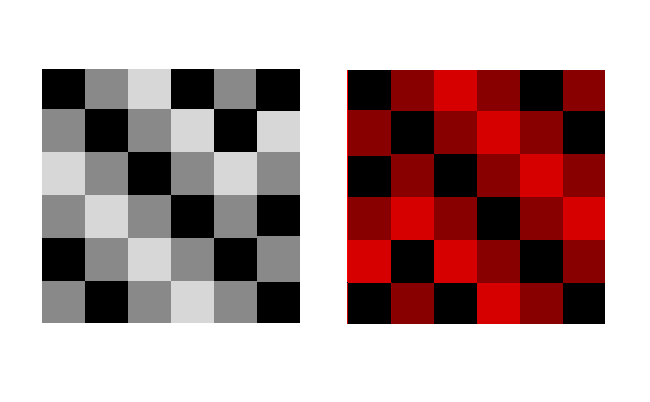
Light-dark contrast
Light-dark contrast decor

3. Contrast cold-warm


It´s greatest effect is achieved with the colours orange-red and blue-green.

Cold-warm contrast

Warm colours
are made with orange, red, yellow and combinations of them all. They are considered warm because they make you think of sunlight and heat. Warm colours are used to make large rooms cozier.

Warm colours decor

Cool colours, such as blue, green and light purple have the ability to calm and soothe and they remind us of water and sky. They are great for small room to seem larger.

Cold colours decor


Using the cold-warm contrast brings balance to room. So, if you want your room to be cozy, have warm colours as the dominant ones and add a few elements with cool colours to balance them / or vice versa.


4. Complementary contrast

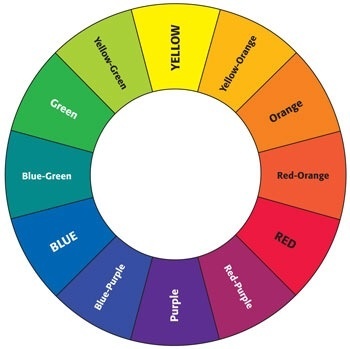
In the colour wheel, the complementary colours occupy opposite positions. When they are mixed, the result is a neutral grey-black. When adjacent, complementary colours mutually intensify their luminosity.

Example:
Yellow-violet
Blue -orange
Red-green
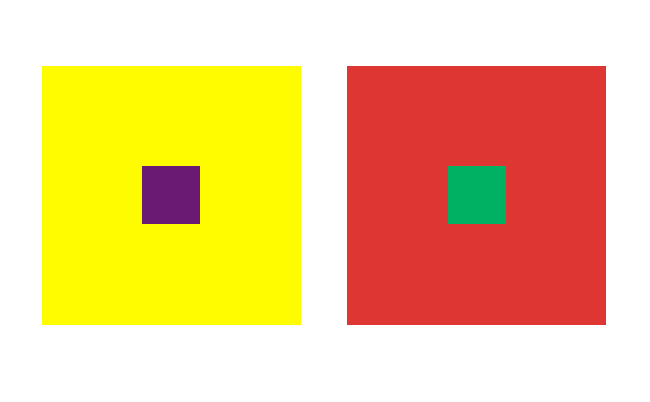
Complementary contrast


5. Simultaneous contrast (optical illusion)

Its effect is derived from the law of complementary colours, according to which each pure colour physiologically demands its opposite colour – its complement. If this colour is absent, the eye will produce it simultaneously. Strong green makes neutral grey next to it appear reddish-grey, whereas the effect of strong red on the same grey is a greenish-grey appearance.
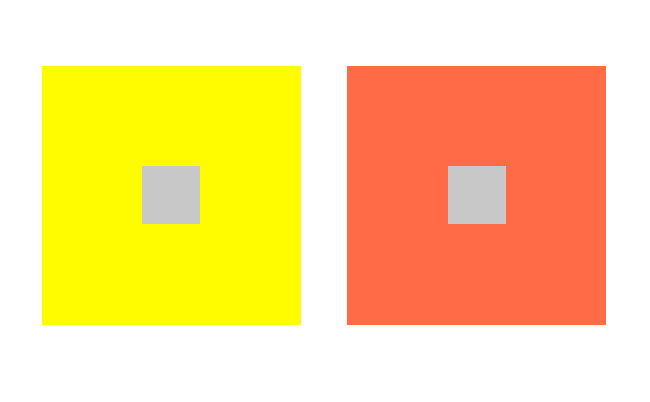
Simultaneous contrast


Simultaneous contrast


6. Contrast of saturation
This is a contrast between luminous and dull colours. Colours can be subdued by the addition of black, white, grey or complementary colours.
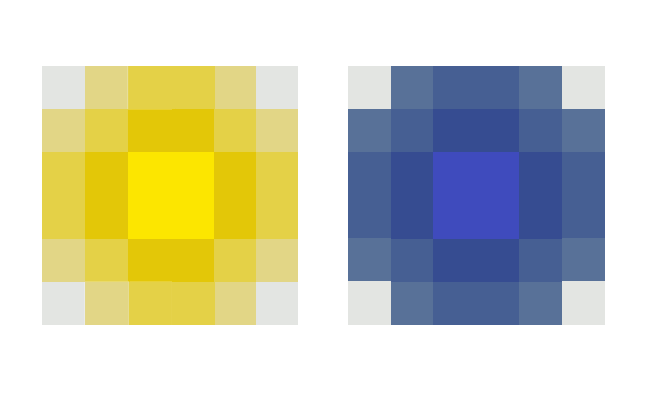
Contrast of saturation

7. Contrast of extention/quantity
It involves the proportion of colours used. Two factors determine the force of a pure colour> its brilliance or lightness of value and its extent. 

Contrast of extention/quantity

Contrast of extension/quantity


Also read: 

How To Use Colors In Interior Design - Part 1: The Basic Color Theory
How To Use Colours In Interior Design - Part 3: The Psychology Of Colours

Friday, 19 April 2013


Before using colors in interior design, it's good to know some important facts about the basic color theory.

The 3 primary colors are red, blue and yellow. They cannot be made by mixing any other colors. These three colors are mixed to create all other colors and can be combined with white or black to create tints (lighter hues) and shades (darker hues) of these colors.

Primary and secondary colors

Secondary colors are created mixing two of the three primary colors together. They are orange, green and purple.

Example of decor based on a primary color - blue 


Tertiary colors are made by mixing one primary color with one secondary color. These colors are red-orange, yellow-orange, yellow-green, blue-green, blue-violet and red-violet.


Primary, secondary and tertiary colors

Additive primary colors are the primary color elements that make up white light. These colors are called additives because you must add the colors together to create white. The additive primary colors are red, green, and blue (commonly called RGB) as they are the primary color elements.

In contrast to combining the additive primary colors of red, green, and blue to make white, subtractive primary colors is a four-color printing process that uses cyan, magenta, yellow and black. This is often referred to as CMYK.

These are the hues, or the twelve purest and brightest colors.They form the full spectrum of colors which progress around the Primary Color Wheel in gradual increments.

Hues - the twelve purest colors
When speaking about colors, we have to know that every color on the Basic Color Wheel can be altered in three ways by tinting, shading or toning.

A tint is a mixture of pure hue and white. Think of a color like red saturated with lots of white. As more white is added the color becomes a lighter and lighter tint of red, until it turns to pale pink.
Tint
The shade of a color refers to how dark it is. It is the combination of a hue and black. Thus, burgundy is a shade of red, hunter is a shade of green, and rust is a shade of orange.
Shade
Shades of a color offer a deeper and richer feeling in decorating and can be used to make any room feel cozier.

A tone is created by adding both white and black which is grey. Any color that is "greyed down" is considered a Tone.
Tone
Complementary colors are pairs of colors that are of  "opposite" hue. In color theory, two colors are called complementary if, when mixed in the proper proportion, they produce a neutral color (grey, white or black). Example of complementary colors:
  •     red and green
  •     blue and orange
  •     purple and yellow
Primary complementary colors

Example of decor using complementary colors - blue and orange

Then, there are the analogous colors. Three colors next to each other on the color wheel comprise an analogous color scheme. Here are three examples:

  •     red, orange, and yellow
  •     green, blue, and purple
  •     yellow, yellow-green, and green
Analogous Colors

Example of a room decorated with analogous colors
In an analogous color scheme, usually one color is dominant and the others secondary in importance.

COMING NEXT:
How to use colors in interior design - Part 2: Color contrast
How to use colors in interior design - Part 3: The color psychology - The meaning of colors


References:

wikipedia.org
interiordec.about.com
color-wheel-artist.com

Social

Find us on Facebook and Pinterest

Total Pageviews

Translate

Contact us

Name

Email *

Message *